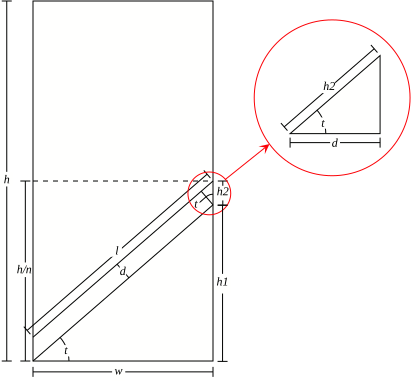
Known values:
\(w \Rightarrow\) width of bay
\(h \Rightarrow\) height of bay
\(n \Rightarrow\) number of crosses in bay
\(d \Rightarrow\) width of dimensional lumber
Solve for:
\(t \Rightarrow\) angle of brace
\(l \Rightarrow\) length of brace
Looking at the larger triangle [\(w, h_{1}\), \(l\)] $$\cos(t)=\frac{w}{l}$$ Solving for \(l\) $$l=\frac{w}{\cos(t)}\label{ref10}$$ The value of \(w\) is known. Finding a soluton for the angle \(t\), gets us the value of \(l\).
The larger triangle yields $$\tan(t)=\frac{h_{1}}{w}\label{ref1}$$ The smaller triangle with hypotenuse of \(h_{2}\) and side \(d\) $$\cos(t)=\frac{d}{h_{2}}\label{ref2}$$ The diagram also yields the observation. $$h_{1}+h_{2}=\frac{h}{n}\label{ref3}$$ Solving equation (\ref{ref1}) for \(h_{1}\) and equation (\ref{ref2}) for \(h_{2}\). The values are substituted into equation (\ref{ref3}) to yield. $$w\tan(t)+\frac{d}{\cos(t)}=\frac{h}{n}\label{ref4}$$ Multply both sides of equation (\ref{ref4}) by \(\cos(t)\) $$w\tan(t)\cos(t)+d=\frac{h}{n}\cos(t)$$ The \(\tan(t)\cos(t)\) is equivalent to \(\sin(t)\) $$w\sin(t)+d=\frac{h}{n}\cos(t)$$ $$w\sin(t)-\frac{h}{n}\cos(t)=-d\label{ref5}$$
The result is the sum of the sine and cosine of the same angle \(t\) in terms of other known values. A function of the form \(a\sin(\theta)-b\cos(\theta)\) results in a phase shift sine curve with new amplitude of the form \(R\sin(\theta+\phi)\). \(R\) is the new amplitude and \(\phi\) is the phase shift where $$R=\sqrt{a^{2}+b^{2}}\text{ and }\phi=\tan^{-1}(\frac{b}{a})$$ Substituting terms into equation (\ref{ref5}) results in $$R\sin(t+\phi)=-d\label{ref6}$$ Where $$R=\sqrt{w^{2}+(\frac{h}{n})^{2}}\text{ and }\phi=\tan^{-1}(\frac{\frac{h}{n}}{w})\label{ref7}$$ Solving equation (\ref{ref6}) for \(t\) $$\sin(t+\phi)=\frac{-d}{R}$$ $$t+\phi=sin^{1}(\frac{-d}{R})$$ $$t=sin^{1}(\frac{-d}{R})-\phi\label{ref8}$$ Equation (\ref{ref7}) expresses \(R\) and \(\phi\) using known values and plugging that into equation (\ref{ref8}) results in our solution for the angle \(t\) as a function of known values $$t=sin^{1}(\frac{-d}{\sqrt{w^{2}+(\frac{h}{n})^{2}}})-\tan^{-1}(\frac{\frac{h}{n}}{w})\label{ref9}$$ Equation (\ref{ref9}) and (\ref{ref10}) gives the solution to the two unknown values.